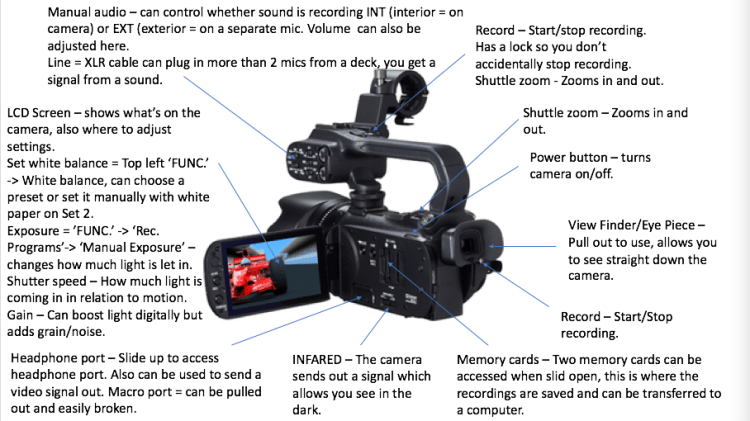
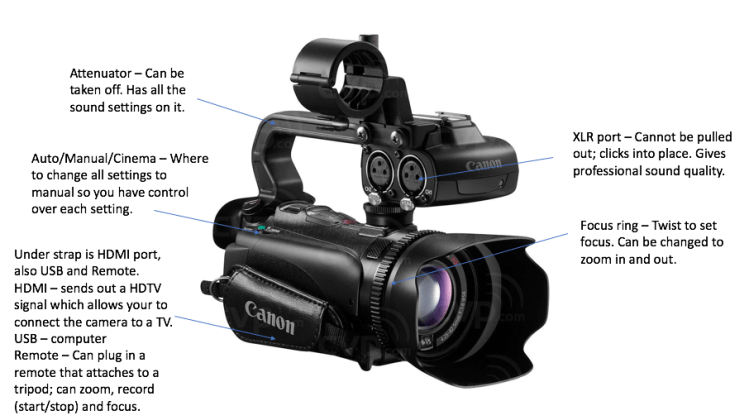
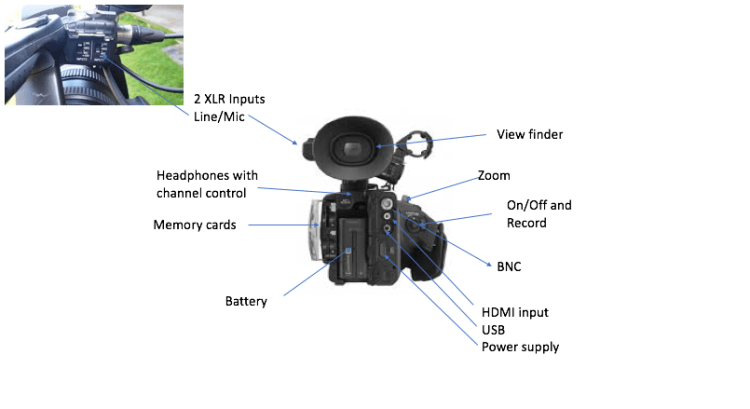
Canon XA10 – Camera Diagram
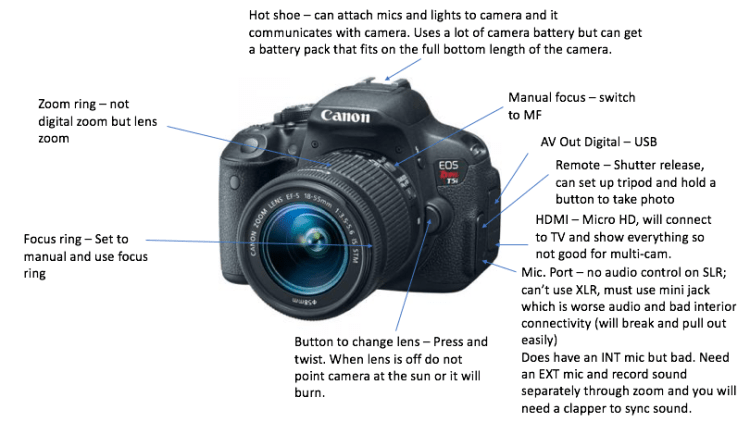
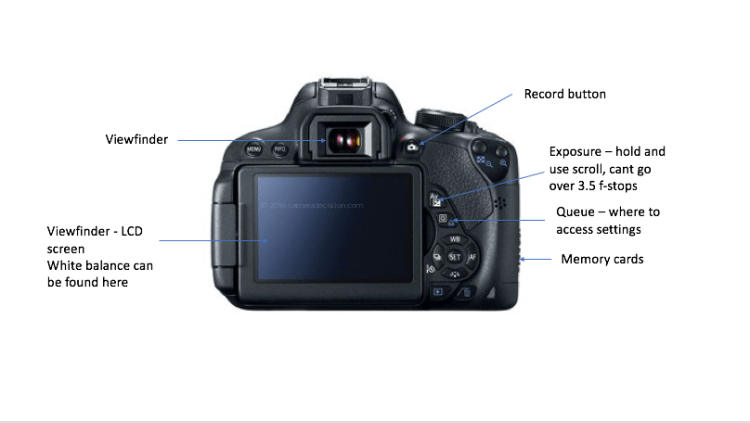
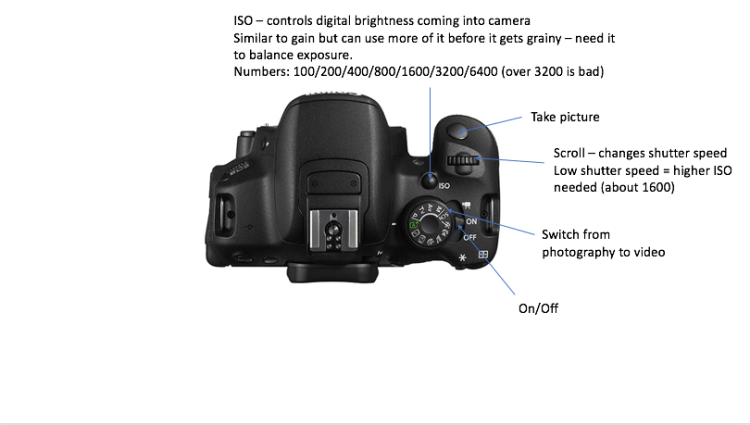
Canon SLR 600/700D
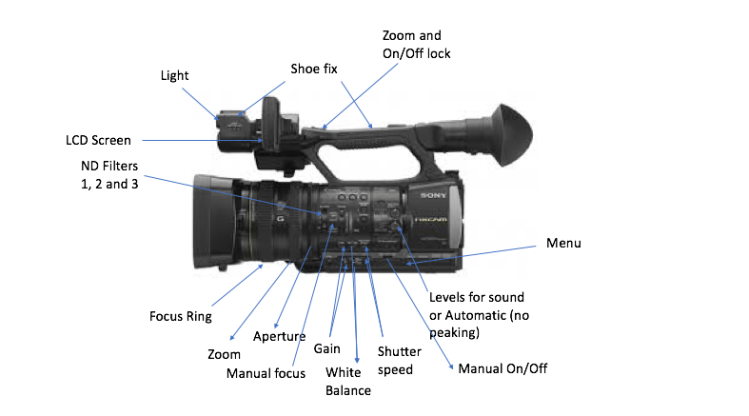
Sony NX3
Demonstrating Camera Features
Explaining the reasons for changing settings.
You would change the settings of a camera based on what you were shooting and where. If you are shooting indoors there is less light, meaning you would have to increase the F-stop and ISO to compensate. Increasing the exposure will also allow you to create a shallow depth of field. Shooting on a 50mm vs a 300mm telephoto lens would create a shallow depth of field without moving the background, wheres the telephoto lens would bring the background closer and therefore look smaller. A lower F-stop (F1.8) will create a shallow depth of field on a 50mm, whereas a higher one will put everything into focus (F15-18). If you are shooting something fast you would increase the shutter speed to around 1/150, but if you are just shooting two people talking you would keep it low on around 1/50 – the standard shutter starting point, as 1/40 will start to show some ghost distortion. Changing the shutter speed requires you to compensate with changing the ISO and exposure as a higher shutter speed makes an image darker. If you are shooting outside you would have a lower exposure as there is more light outside, especially if it is sunny and bright (around F2.8 for indoors vs F8 for outdoors). You would also change the white balance based on whether you are outdoors or indoors as the light sources are different colours – indoors the light looks orange whereas outdoors the light looks blue. You would change this by pointing the camera at a piece of white paper and setting the white balance manually, or by using presets.
Photography Triangle

Notes:
Cinematographers have a style. However, Robert Dicin is one of the best cinematographers because all of his films look different – he can adapt visually – the best cinematographers are the ones who you cant tell made the film u watched.
You can create depth of field with a fixed cam – we want to direct the audience’s view otherwise there are distractions that take away from what is happening. But we do need them otherwise it won’t look real; focus in on the real element.
ND filters – NX3 has two layers. ND filters are a translucent black filter over the lens -you can take it off (glass) and drop the F-stop by 2-3 – good for details in clouds. Or use ND grad which makes the sky look better but the land isn’t affected.
50mm good for portraits but stuck with composition. You can’t focus when really close to the subject. Opens up to F1.8.
Telephoto lense – filmmaking unobtrusively. It creates a sense of looking in (from afar). Brings the background closer and makes it blurry – change with zoom and compensate with exposure and ISO.
Macro lenses can go really close and will be focused. 75-300. 90mm
Fisheye – bevel makes it look wider. Get a big ring of black around it (picks up edge of the black camera – creates a keyhole effect – need to zoom in to remove it. Sees up to 180 degrees. This is why security cameras are very distorted.
https://hpocrunit18.wordpress.com/
 Eesha's Unit 18 Blog